
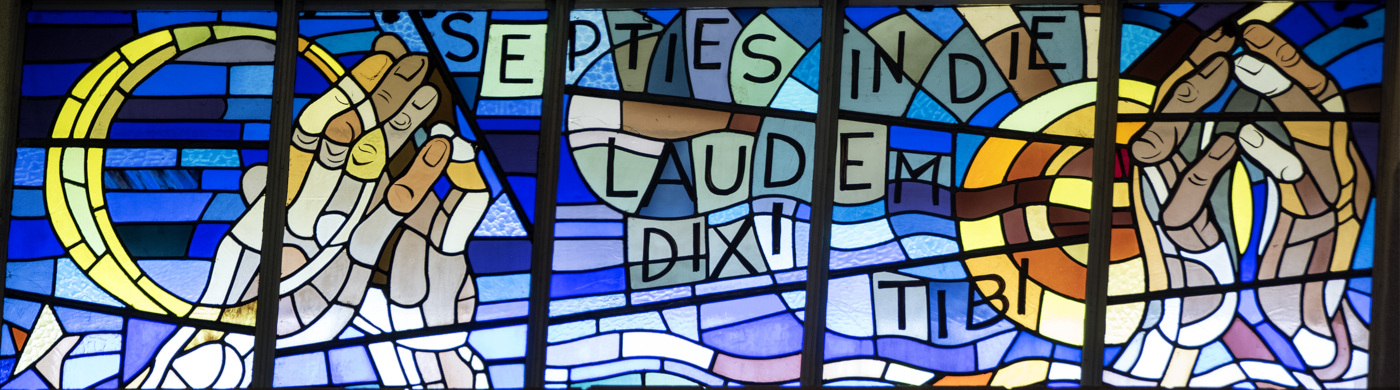
Reading: Isaiah 52:7-10; Psalm 98:1-6: Hebrews 1:1-6; John 1:1-18
ABBOT LAWRENCE – ST. GREGORY’S ABBEY
Back in the days of my childhood there was a little rhyme that almost every elementary school kid knew: Sticks and stones may break my bones, but words will never hurt me. Every child who was being taunted, ridiculed or verbally bullied would know to recite this little jingle. But every child who was being taunted, ridiculed or verbally bullied also knew something else: it was a lie. Words can hurt; words do hurt. In fact, words can inflict longer-lasting wounds and deeper scars that many sticks and stones. The wounds and scars inflicted by words can last for a lifetime. Sometimes the injuries never really heal. Sometimes the injuries are fatal.
Words can wound and scar because words matter. Words from those who are supposed to be trustworthy carry the greatest sense of importance: parents, older siblings, teachers, reporters, elected officials or leaders in the Church. But all of us should be mindful of how we use words. St. Benedict writes that there are times when even good words should be left unsaid out of esteem for silence. (RB 7) Insults, put-downs and lies can undermine confidence and a person’s sense of self-worth not only in children, but also adults. On the other hand, words of encouragement, praise, gratitude and truth can turn failures into learning experiences, exhaustion into a sense of accomplishment, set-backs into stepping stones. Ill-conceived or false words can put one down a path of destruction for one’s self and others. Courageous and truthful words, especially in the face of injustice, can ennoble the person who utters them. Words can tear down nations, or inspire the establishment of “a more perfect union.”
Today, on this solemnity of the Nativity of Our Lord Jesus Christ, we celebrate the greatest Word of All: the Word of God and the coming of that Word in our humanity, in our human experience, to save us from the powers of darkness and bring us into the Kingdom of the Children of Light. As the Letter to the Hebrews puts it: “In times past, God spoke in partial and various ways to our ancestors through the prophets; in these last days, he has spoken to us through the Son, whom he made heir of all things and through whom he created the universe, who is the refulgence of his glory, the very imprint of his being, and who sustains all things by his mighty word.” So clearly did God wish to reveal himself that “the Word became flesh / and made his dwelling among us, / and we saw his glory, / the glory as of the father’s only Son, / full of grace and truth.”
But even as God has revealed himself in a clear and definitive way in his own beloved Son, not all have recognized or accepted this Word of God, through whom all things were made. Although “the world came to be through him, … the world did not know him.” Even his own people did not accept him as the long-awaited fulfillment of the promises spoken by God through the prophets in times past. Nor have those who believe always been courageous in proclaiming the truth of the good news of Jesus Christ. Thanks be to God, the Word of God endures and continues to reverberate down to our own day, full of grace and truth.
Other than the Blessed Virgin Mary, John the Baptist was the first to understand that Jesus was the fulfillment of the Word of God. Scripture describes how John leapt for joy in his mother’s womb when Jesus approached in the womb of his mother Mary. (LK 1:44) During his life, John was filled with the Holy Spirit and courageously testified to the light of truth to be found in God’s Word. And, when the time came, John cried out to those who could hear; “This was he of whom I said, ‘The one who is coming after me ranks ahead of me, / because he existed before me” (JN 1:15) and “he must increase while I must decrease.” (JN 3:30) John cried out the “good news, announcing salvation” and leading others to the light and truth of the Word of God. Many accepted the spoken testimony of John, and came to discover for themselves the salvation of God, accepting Jesus and though him becoming the beloved children of God.
My brothers and sisters, this great Word of God is spoken to us today. Once again we hear the good news that God is faithful to the word of His promise, and that this divine Word has come to set us free from the power of darkness and to transform us into children of light who know the salvation of God. Yes, in our lives we have known and will know the blows of sticks and stones, and the painful wounds of words that would tear us down, discourage us and make us give up on life. And, yes, through our own sinfulness each of us no doubt has spoken words that have wounded others.
And yet, these destructive words need not be the words that define us or govern us. No. Rather, God still speaks to us not a message of condemnation, but a message of reconciliation, not a message of destruction but a message of restoration, not a message deceit and darkness but a message of truth and light. As our gospel today tells us: “From his fullness we have all received, grace in place of grace, because while the law was given through Moses, grace and truth came through Jesus Christ.” The Word of God is what is meant to define us – and it can through the grace of our Newborn Savior if we but hear it, receive it and live it. The testimony of John still rings true for us today and points us toward the salvation of God in Jesus Christ, the Word of God Made Flesh, the Light of the World, and the “refulgence” of the glory of God. May we, like John the Baptist, be filled with the Holy Spirit so that we courageously will give witness to the Word of God, Jesus Christ, who comes to reveal the glory and salvation of God!