
Abbey Church Window Tour
West Facade
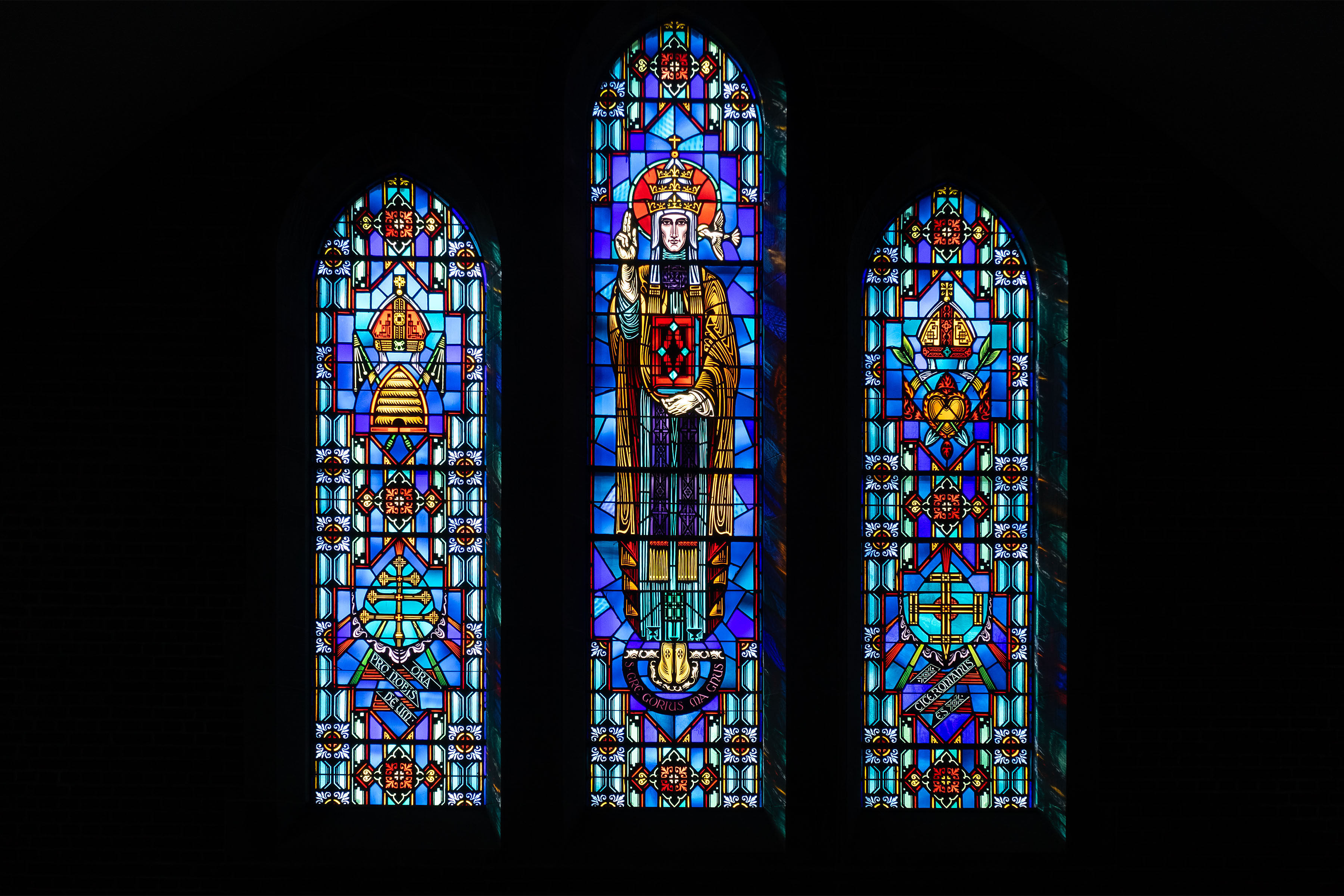
In the west façade of the church are three large windows. The middle one represents St. Gregory the Great, the first to become Pope and the patron of the Abbey. His right hand is lifted in blessing and his left hand holds the Bible. A dove at his ear represents the Holy Spirit inspiring him to write several commentaries on Sacred Scripture, the liturgy and pastoral care of souls.
The two side windows memorialize four of the great “doctors” or theologians of the Church. In the upper left, St. Ambrose, Bishop of Milan (c. 339-397), is represented by a miter and a beehive that recalls the sweetness of his preaching. The scourges indicate his life of penance. The lower left recalls St. Gregory Great (c. 540-604) with a papal cross and the Latin phrase “Ora pro nobis” meaning “Pray for us.” In the upper right St. Augustine of Hippo (354-450) is depicted by a miter placed over a heart with flames and pierced by two arrows. This depicts his burning passion for God and his heart pierced with love of God and neighbor. Finally, St. Jerome (c. 342-420) is represented by a cross potent often associated with Jerusalem and his Latin translation of the Bible. The phrase “Ciceronianus Es” means “You are a Ciceronian.” It recalls a dream of St. Jerome in which he was rebuked by Jesus for having more passion for the secular writings of Cicero than for the Word of God.
Window 1 - Advent
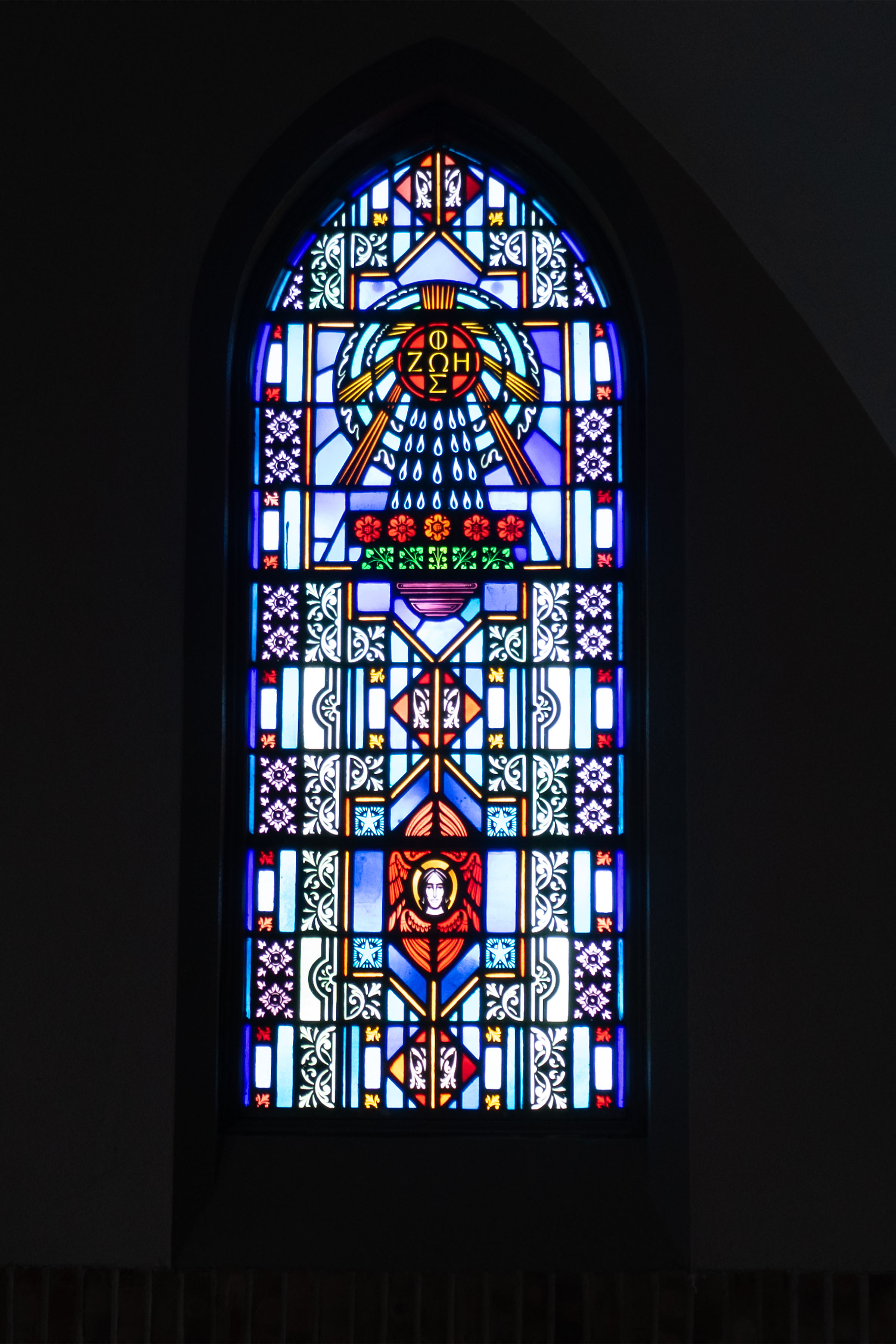
This window represents Advent, the season of preparation for both the celebration of the birth of Jesus at Christmas and the second coming of Christ in glory. In the window drops of dew descend from a cross with the Greek words ΦΩΣ (phos) and ΖΩΗ (zoé) meaning light and life. This represents light and life of Christ raining down upon the earth causing salvation to spring up like flowers, as foretold in Isaiah 45:8.
Window 2 - Christmas
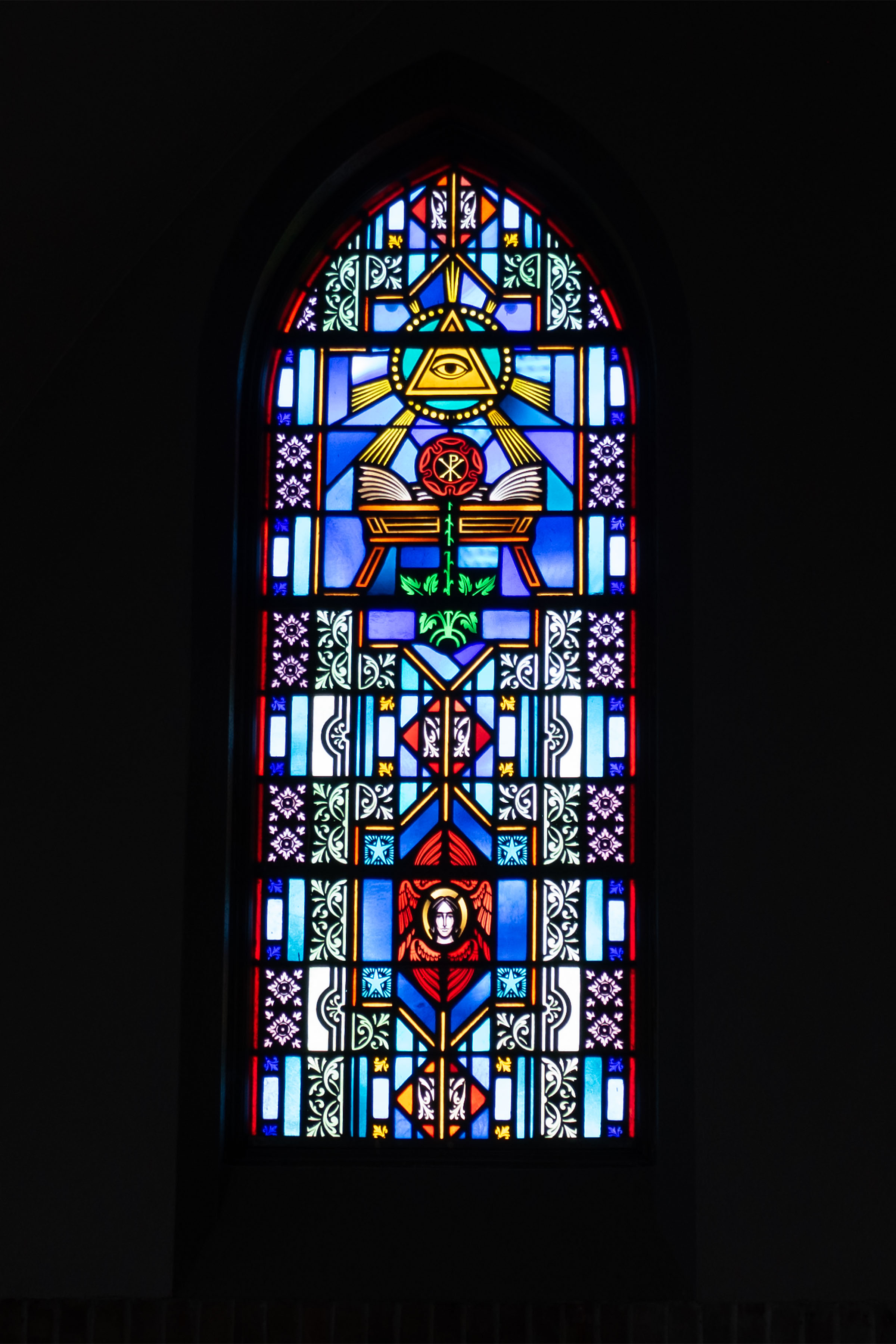
This window depicts Christmas and the birth of Jesus in humble circumstances with his crib being a manger filled with straw. Above the manger is a triangle and eye within it, symbolizing the omniscient (all-knowing) God. The newborn Jesus is represented by a rose, a reference to the prophesy of Isaiah 11:1 – “from the root of Jesse a bud shall blossom.” On the rose are the Greek letters Chi and Rho, that look like the Latin “X” and “P.” These are the first two letters of “Christ” and represent Jesus Christ in Christian symbolism.
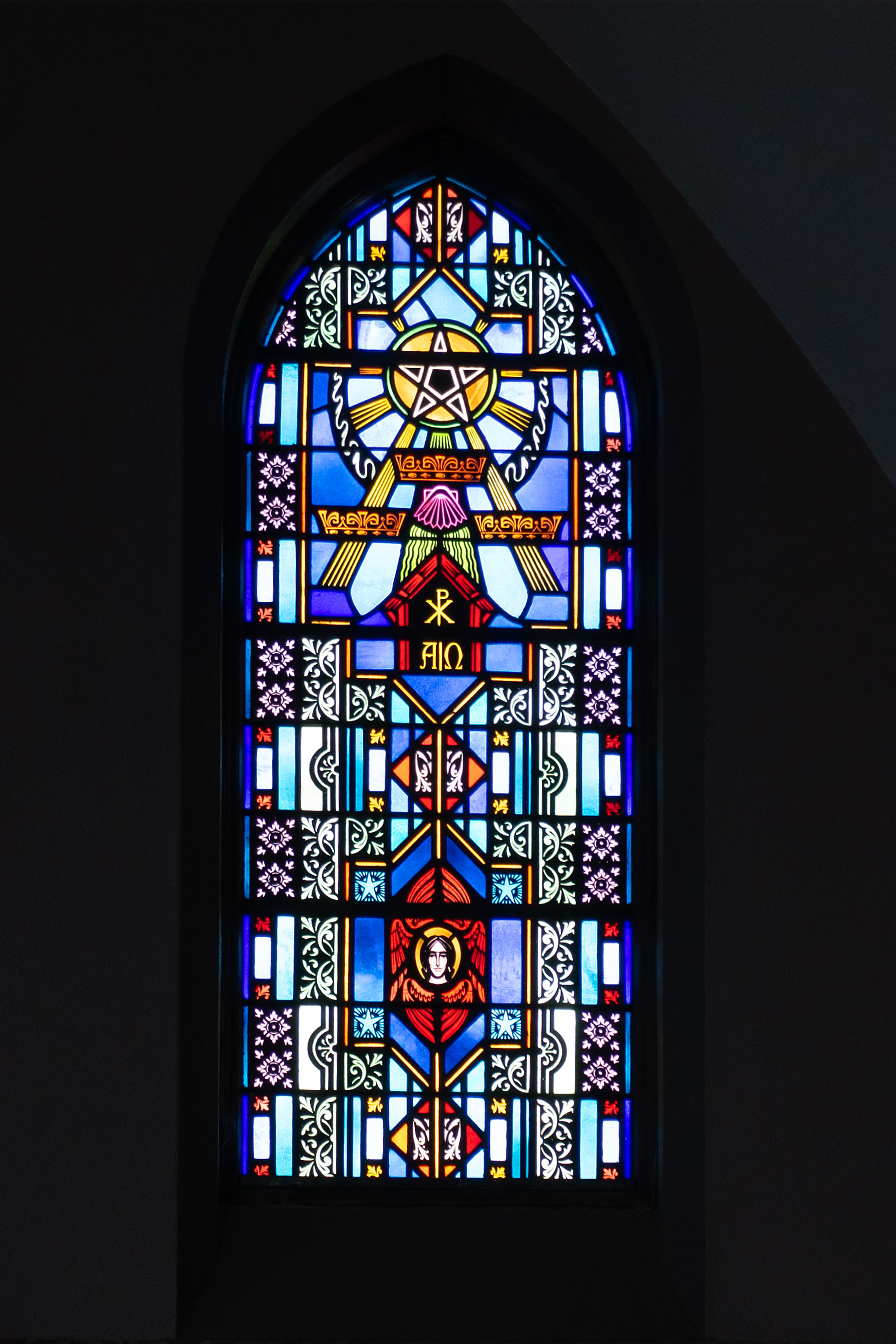
Window 3 - Epiphany
This window represents Epiphany, the manifestation of the Messiah to all the nations. In the small house we see a Chi-Rho along with the first and last letters of the Greek alphabet, Α (Alpha) and Ω (Omega) Together these represent “Christ: the beginning and the end of all.” Three crowns represent the “wise men” or “magi” from the East who followed the new star to pay homage to the “newborn king of the Jews.” The seashell represents the Baptism of the Lord, when the voice of the Father proclaims Jesus as His Beloved Son. (Matthew 3:17)
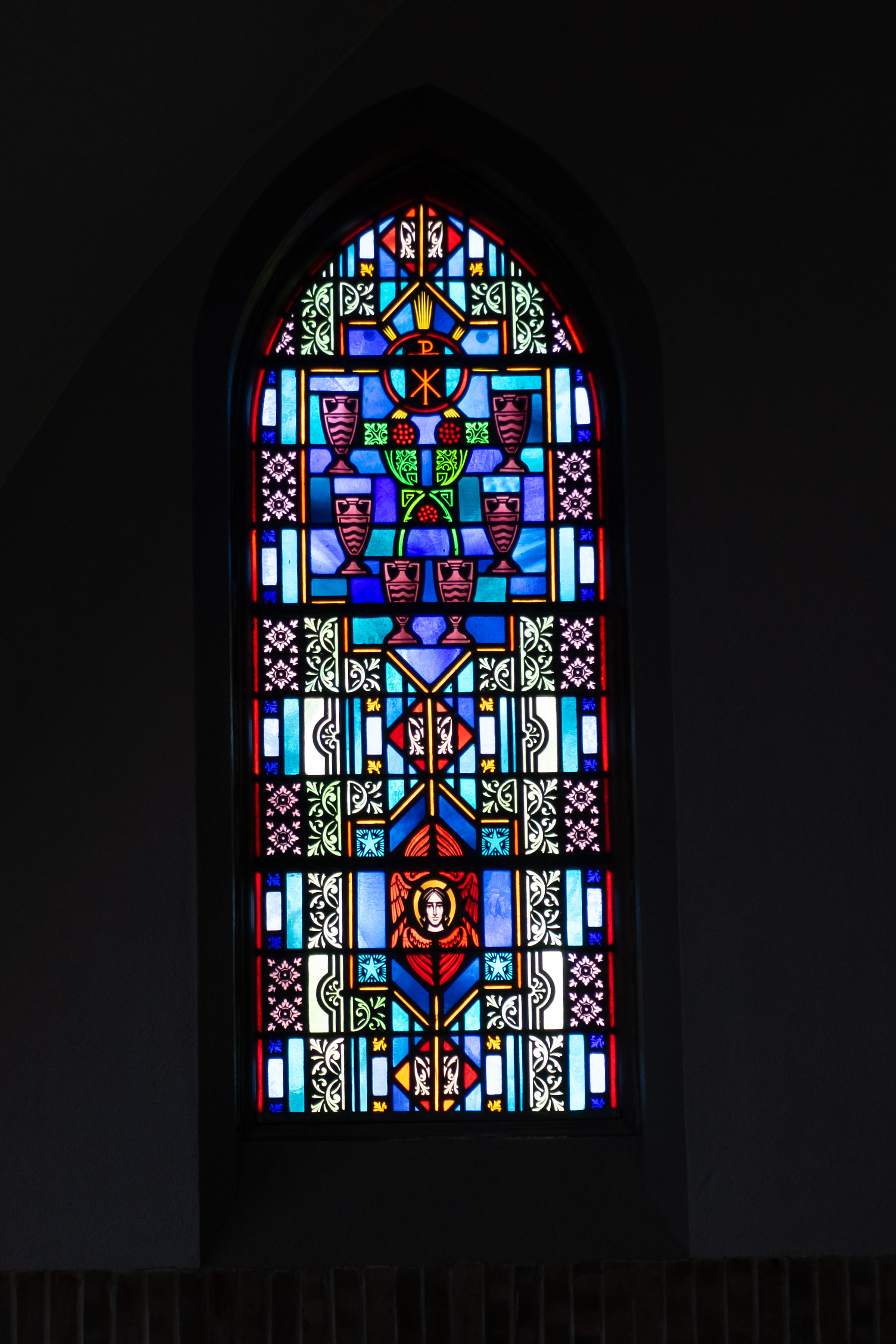
Window 4 - Wedding at Cana
The theme of Epiphany continues in this window depicting the first miracle of Jesus at the Wedding of Cana. (John 2:1-11) The Chi-Rho along with grapes and six jars represent Jesus changing water for ceremonial washings into fine wine for the wedding banquet. This fulfills the prophesy of the Messianic banquet proclaimed in Isaiah 25:6-12.
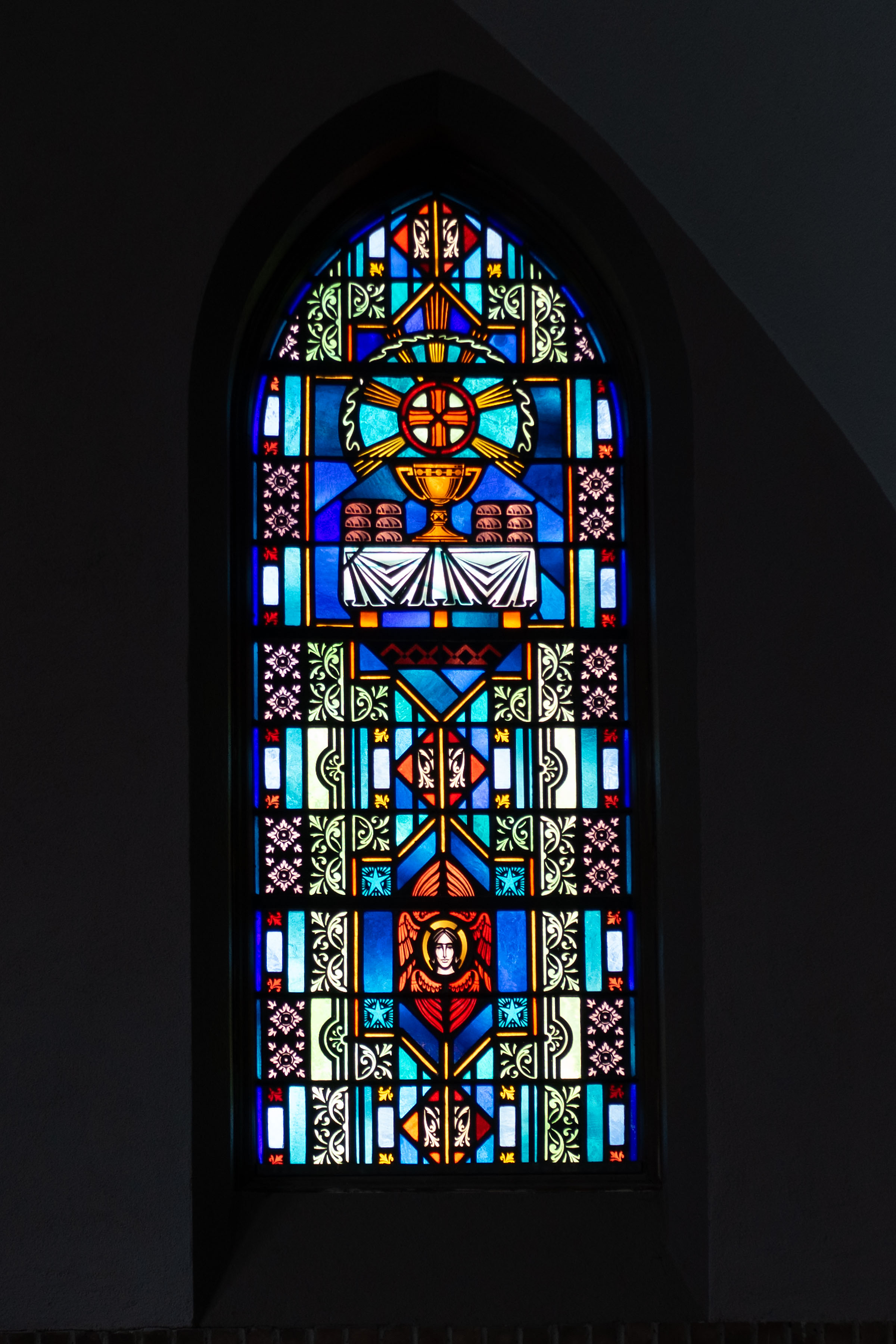
Window 5 - Holy Thursday
This window depicts Holy Thursday and the Last Supper, during which Jesus instructed his Apostles and established the New Covenant meal of the Eucharist, in which bread and wine are transformed into the Body and Blood of Christ. Christ, represented by the cross, presides over the chalice with twelve loaves of bread. The Mass makes us present to this Supper of the Lord and continues to nourish the Church with the Body and Blood of Jesus until he returns in glory.
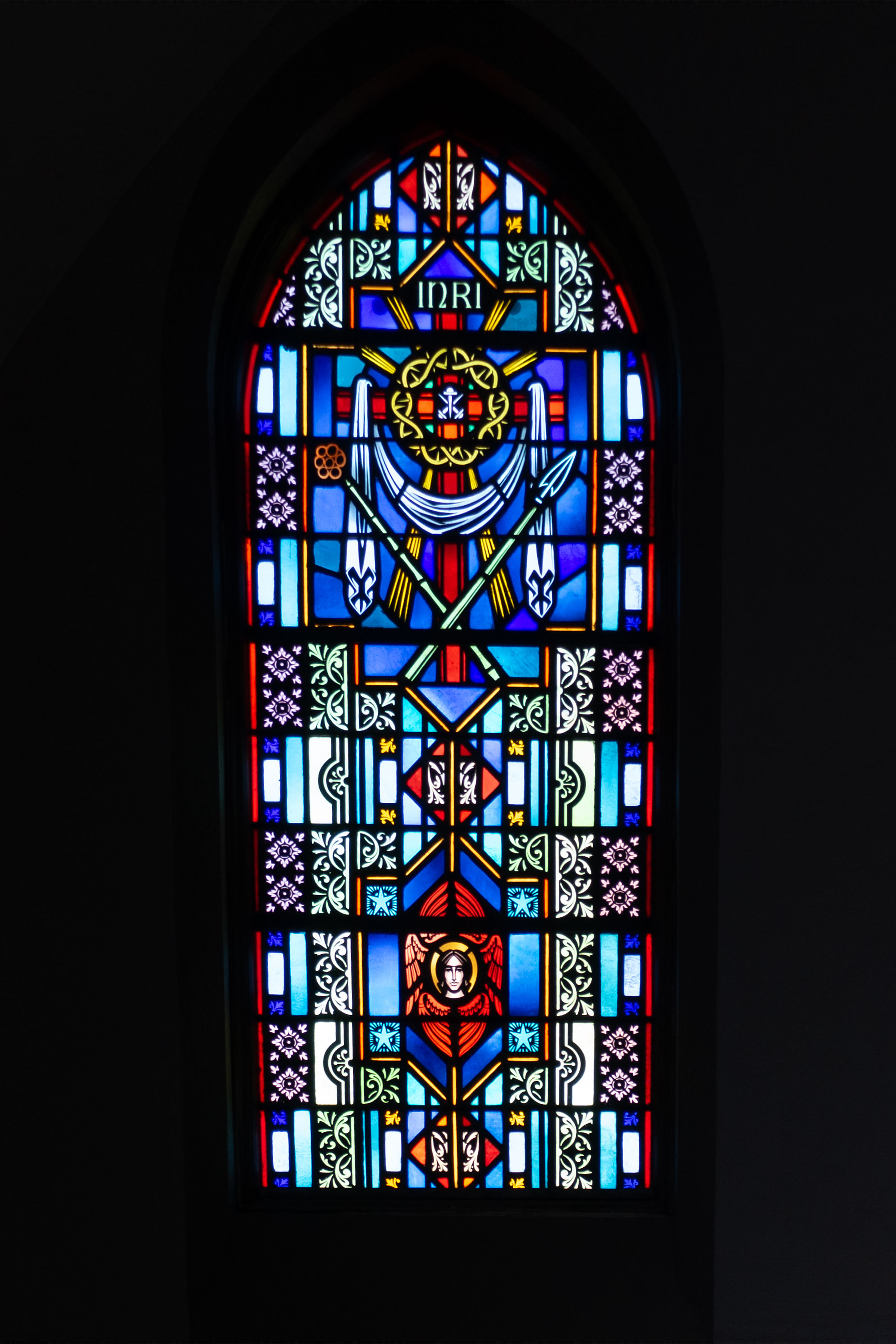
Window 6 - Good Friday
Depicting Good Friday, this window incorporates the instruments of the passion and death that Jesus endured for the salvation of all. Presented are the cross, the crown of thorns, three nails, a sponge soaked in wine and lifted on a reed to Jesus when he was on the cross, the spear which pierced his side, and the shroud in which his body was wrapped. The letters INRI on the crucifix stands for the Latin phrase “Iesus Nazareus Rex Iudaeorum” which means Jesus of Nazareth, King of the Jews.
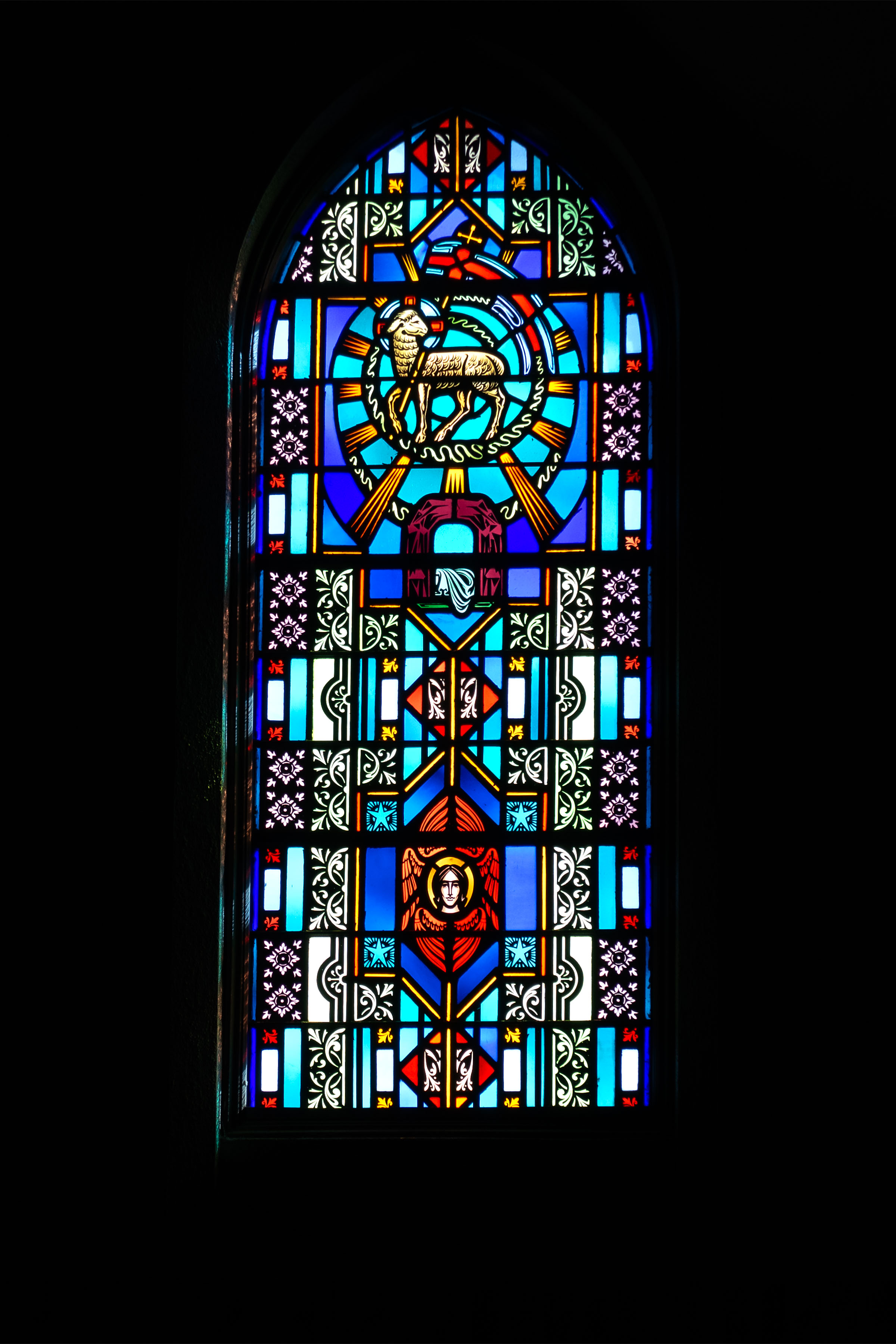
Window 7 - Easter
The windows depicting the liturgical cycle of the church continue on the opposite (south) side of the nave. The first window depicts Easter, when Jesus conquered the power of death through the triumph of the resurrection. It features an empty tomb and the discarded burial shroud. Above the empty tomb is the victorious “Lamb of God” with the banner of victory over sin and death.
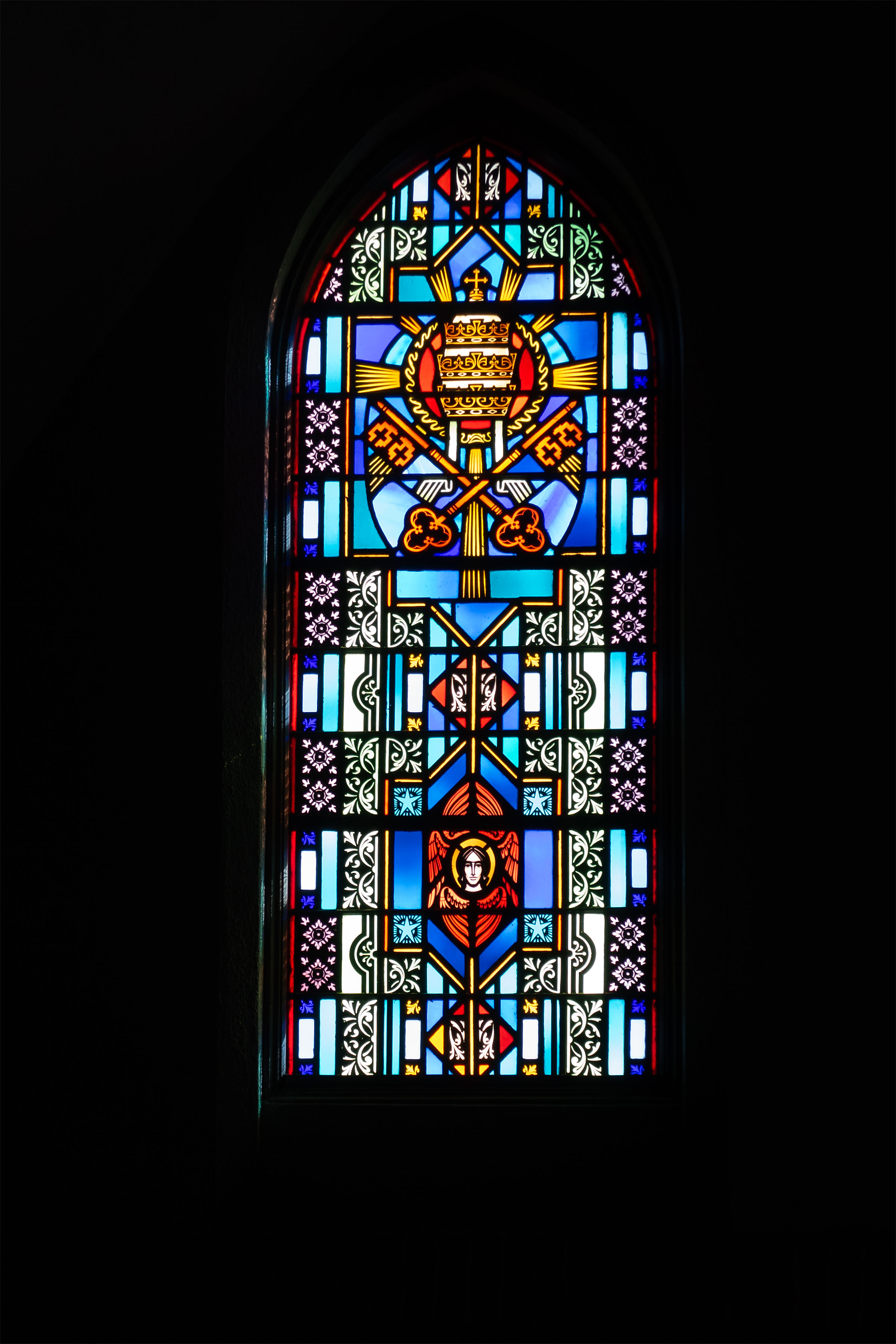
Window 8 - Ministry of St. Peter
This window recalls John 21:15-19. In this episode, Jesus three times asks St. Peter if he loved him, thus overcoming the three times that Peter denied knowing Jesus. Jesus then entrusts St. Peter with the responsibility to shepherd and feed the flock of all believers. This fulfills the words of Jesus in Matthew 16:13-19 and confirms the role of St. Peter as the “rock” upon which
Jesus would build his Church, with authority to “bind and loose” sins. The papal tiara along with the crossed keys represent this divinely appointed authority entrusted to St. Peter and his successors with the unique “Petrine Ministry” that rests with the Pope.
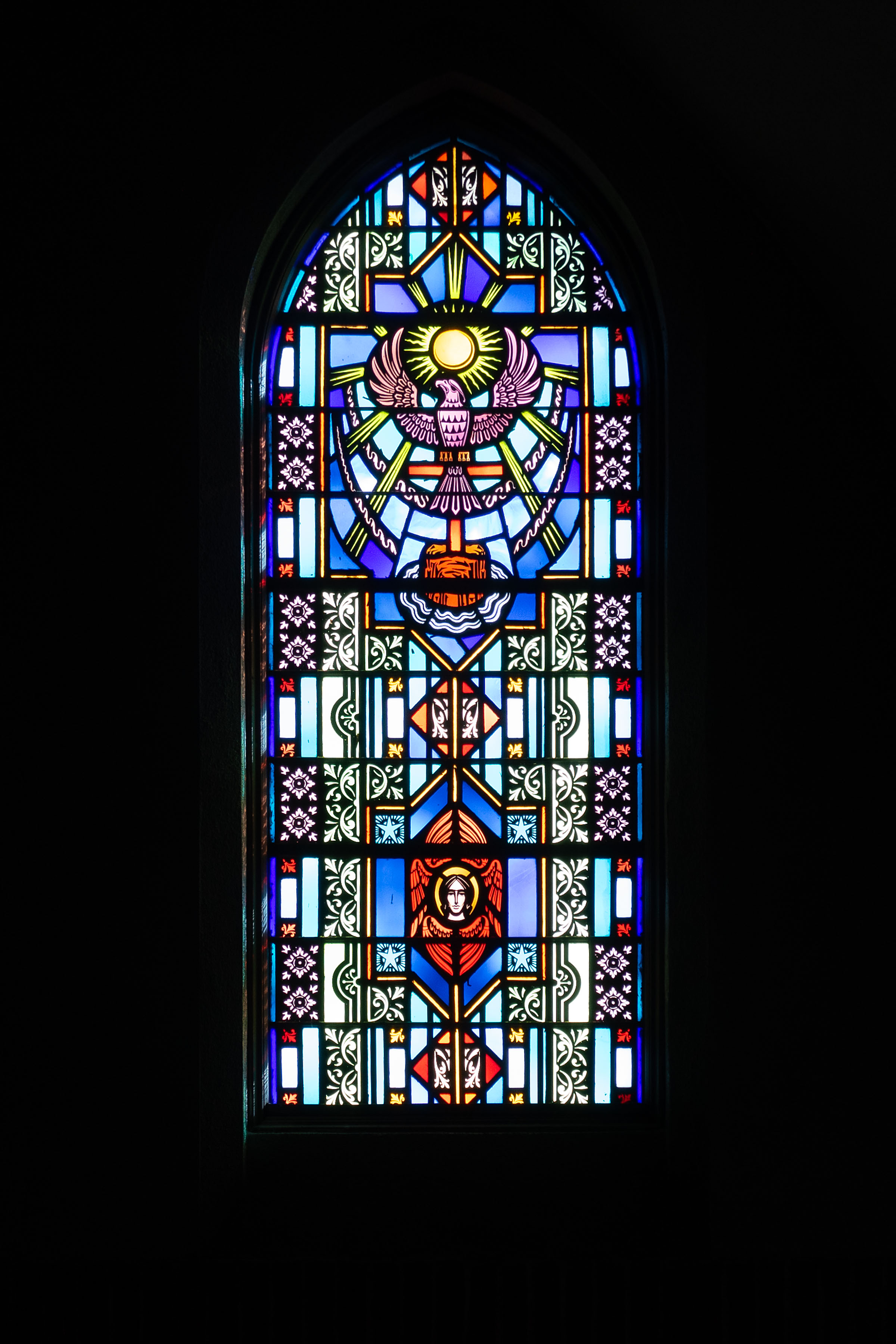
Window 9 - Ascension
This window depicts the Ascension of Jesus into heaven by using the ancient image of the phoenix rising with the splendor of the sun. According to mythical traditions based in ancient Persia, the phoenix lived for a thousand years, then died only to rise to new life from its ashes. Early Christians saw this as an appropriate symbol for the Resurrection and Ascension of Jesus. Below the phoenix is a rock surrounded by water. This is a reference to the waters of baptism, through which the Christian dies with Christ and rises in Christ to new life and the promise of future resurrection.
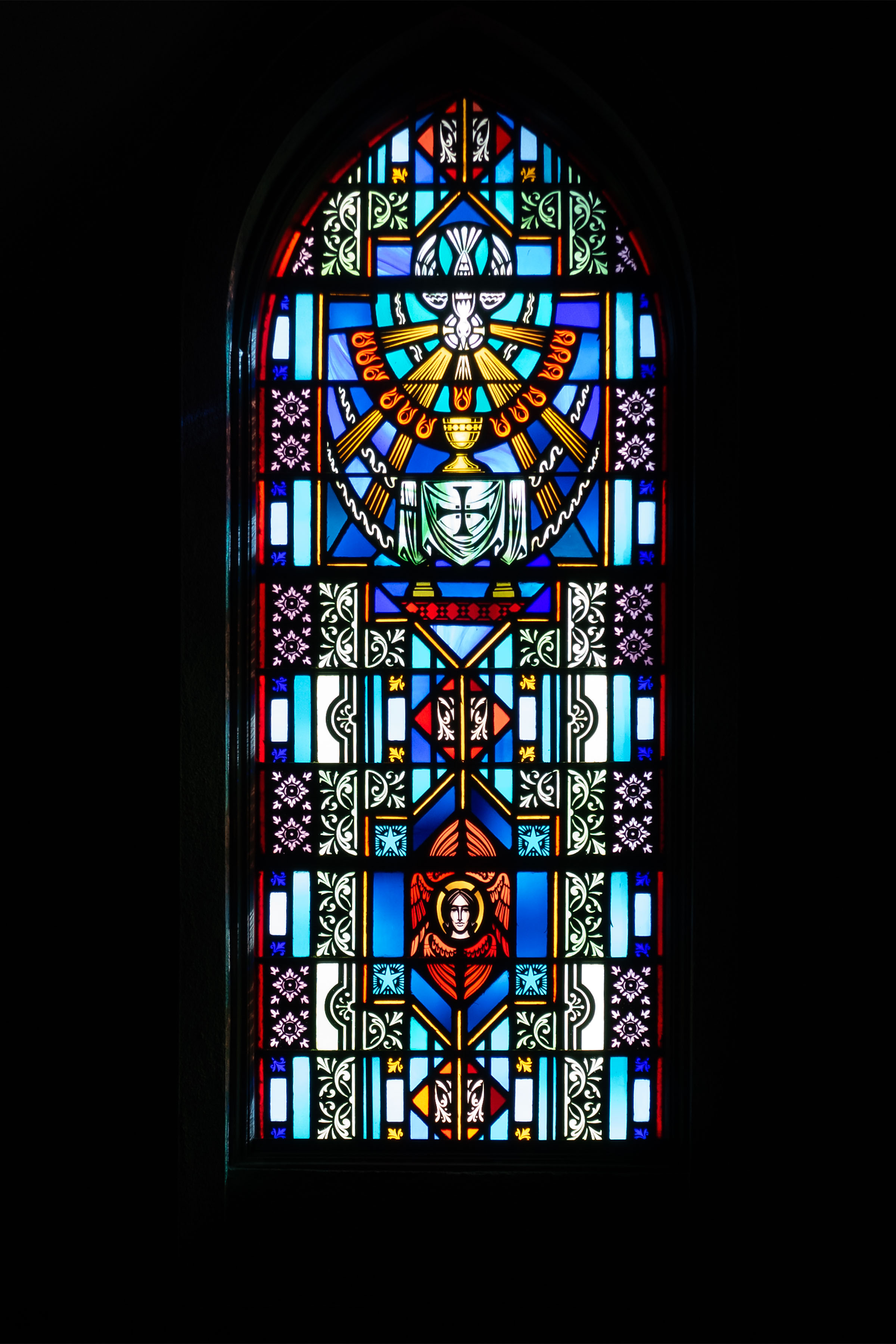
Window 10 - Pentecost
This window depicts Pentecost and the coming of the Holy Spirit upon the Church fifty days after Easter. The Holy Spirit descends in the forms of a dove and tongues of fire as described in the Acts of the Apostles 2:1-4. The chalice and table with the cross recall the upper room as depicted in the window for Holy Thursday. Thirteen tongues of fire descend upon the apostles and the Church, who through the Holy Spirit are to preach the gospel fearlessly in all languages with the seven-fold gifts of the Spirit prophesied in Isaiah 11:1-2. These gifts are represented by the seven rays coming from the Holy Spirit. With Pentecost the age of the Church begins.
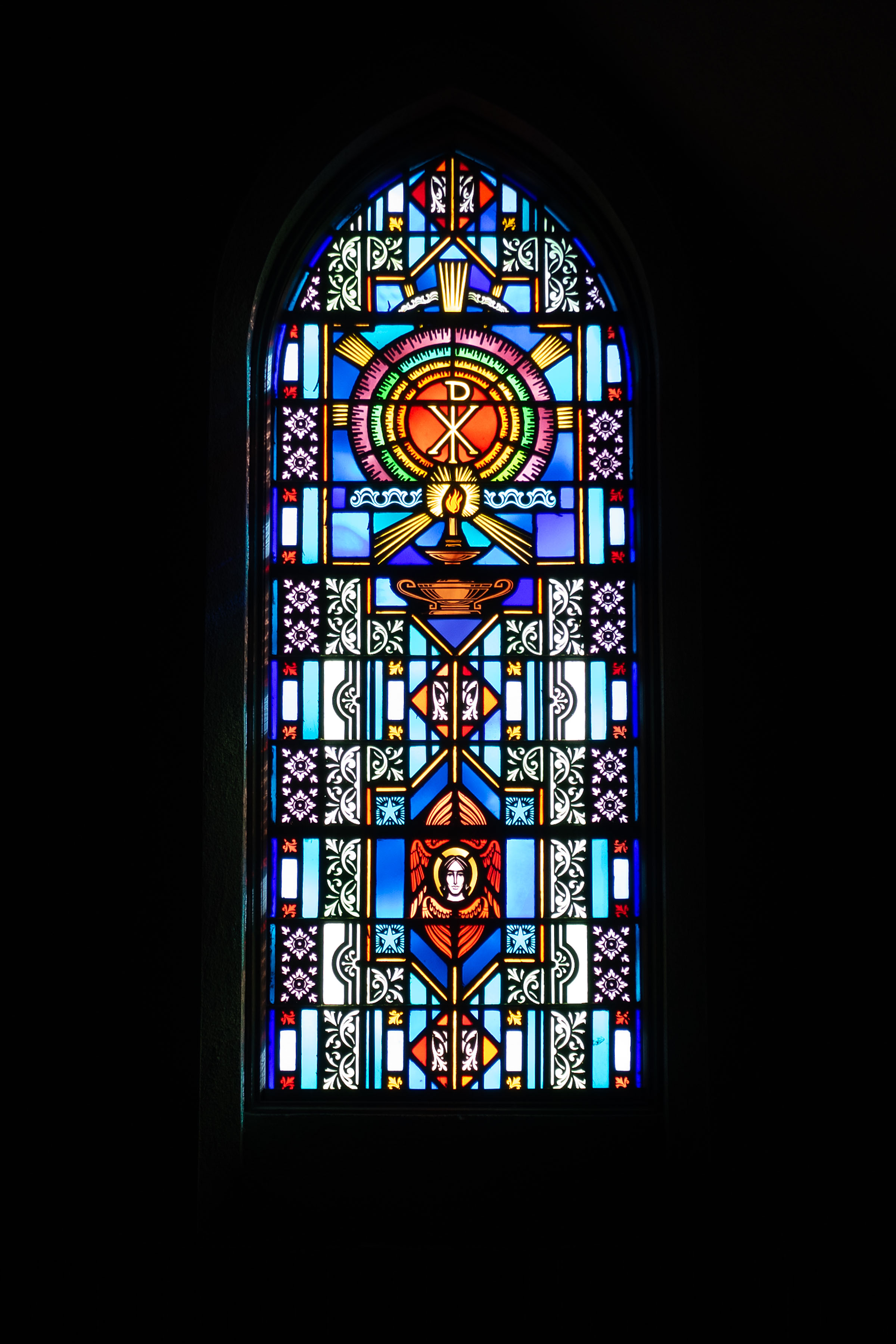
Window 11 - The Glorious Return of Christ
This window anticipates the return of Jesus Christ in glory at the end of time. Jesus Christ is represented by the Chi-Rho radiant with all the glorious colors of the spectrum. The candle burning brightly represents how all disciples are to be prepared always for the glorious coming of the Lord at an hour we do not know. (cf. Luke 12:35-37, Matthew 25:1-13)
South Choir Windows (Organ Side)
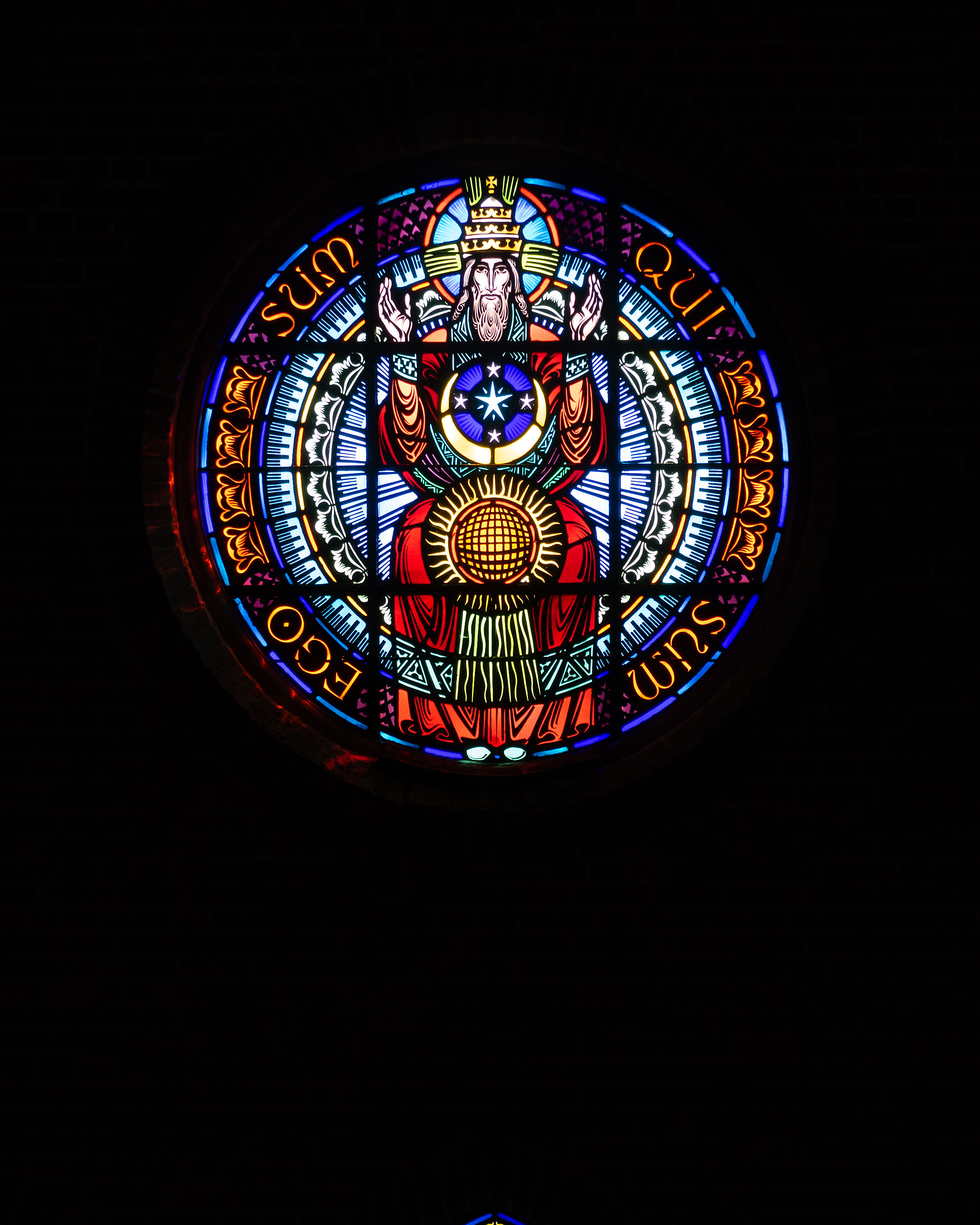
The round upper window depicts an Old Testament understanding of God. God is depicted as Creator and Ruler of the universe, holding the sun, the moon, and the stars under His watchful gaze and care. The Latin words Ego sum, qui sum, translated as I am, who am, represent the Holy Name that God revealed to Moses on Mount Horeb in Exodus 3:14.
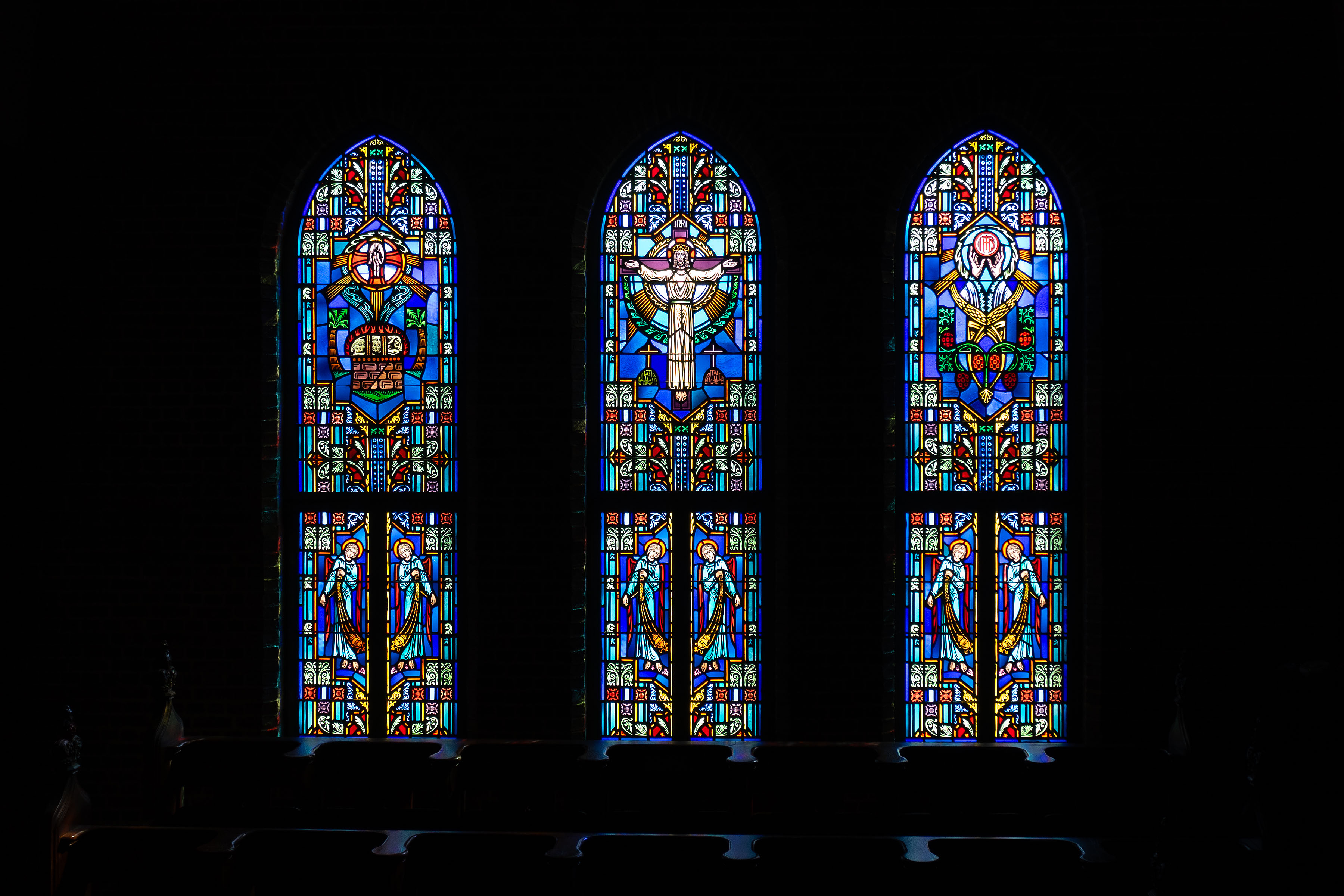
The three lower windows depict sacrifice and covenant. On the left the artist shows the sacrifices of the Hebrew people in the desert and the hand of God reaching down to receive the burnt offering. The middle window shows the perfect sacrifice of Jesus on the Cross of Calvary. Crowned with thorns, Jesus is on the center cross and is flanked by the crosses of thieves crucified with him. The cross on the green mound represents the “good” thief to whom Jesus promises paradise. The cross on the brown or sterile mound represents the unrepentant thief. The right window depicts the sacrifice of the Mass, which makes us present to the Last Supper and Calvary. Wheat and grapes represent the bread and wine offered by the People of God to be transformed by Christ into his Body and Blood. The hands of a priest hold up the consecrated host of this Eucharistic offering in perfect praise of the Father.
North Choir Windows
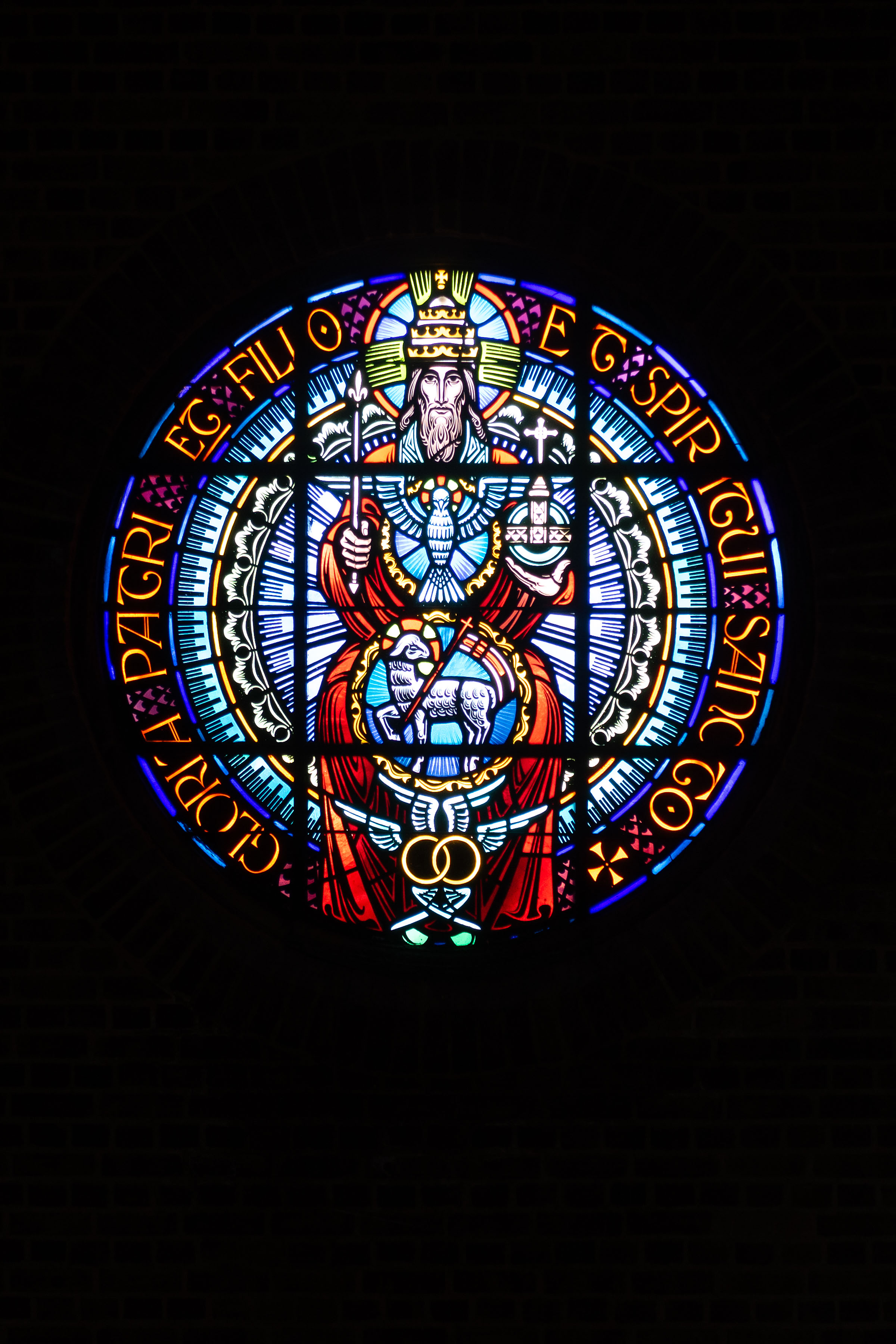
The upper window illustrates the revelation of God as the Most Holy Trinity. God the Father is depicted as a ruling elder, Jesus as the Lamb of God, and the Holy Spirit as a dove. The two gold rings represent the two inseparable natures of Jesus Christ as human and divine. The Latin words “Gloria Patri, et Filio, et Spiritui Sancto” are the doxology “Glory be to the Father, and to the Son, and to the Holy Spirit.”
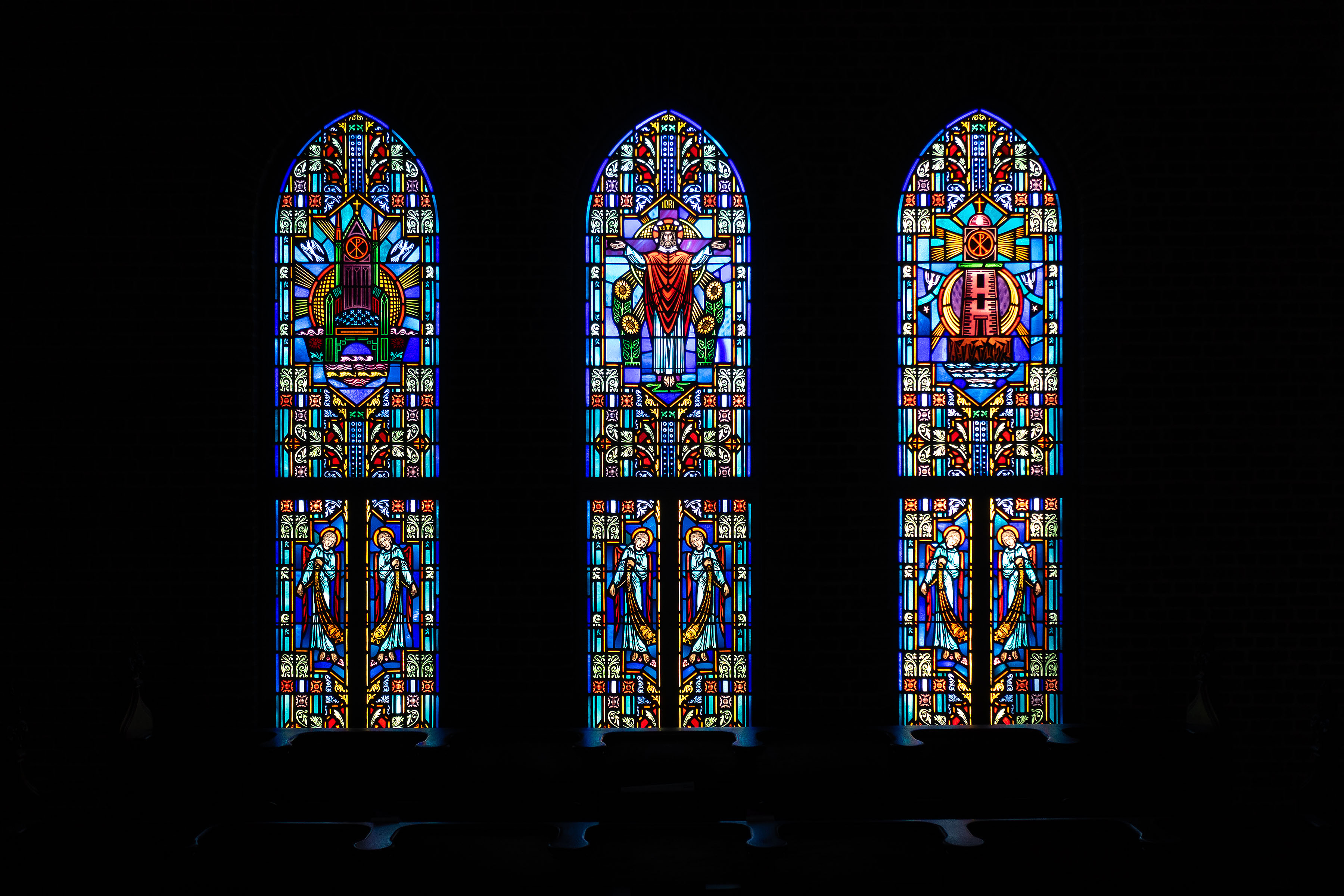
he three lower windows together depict the Liturgy of the Hours, and the call to pray at the beginning, middle and end of the day. The window on the left depicts morning prayer or lauds.
Christ, symbolized by a Chi-Rho, is enthroned. The sun rises and birds fly upward to greet the new day. The middle window shows Jesus wearing priestly garments and crowned with gold as the Glorious King in victory over sin, shown as a serpent under his feet. The sunflowers turn toward Jesus, in praise of the Son of God and Light of the World. The right window depicts evening prayer or vespers. The sun becomes darkened by night, stars emerge, and birds fly downward to their nests. Christ is depicted as a lighthouse topped with a Chi-Rho, to guide us through darkness and the dangerous waters that lash against the rock of Christ. (cf. Matthew 7:24-25)
The Vestibule
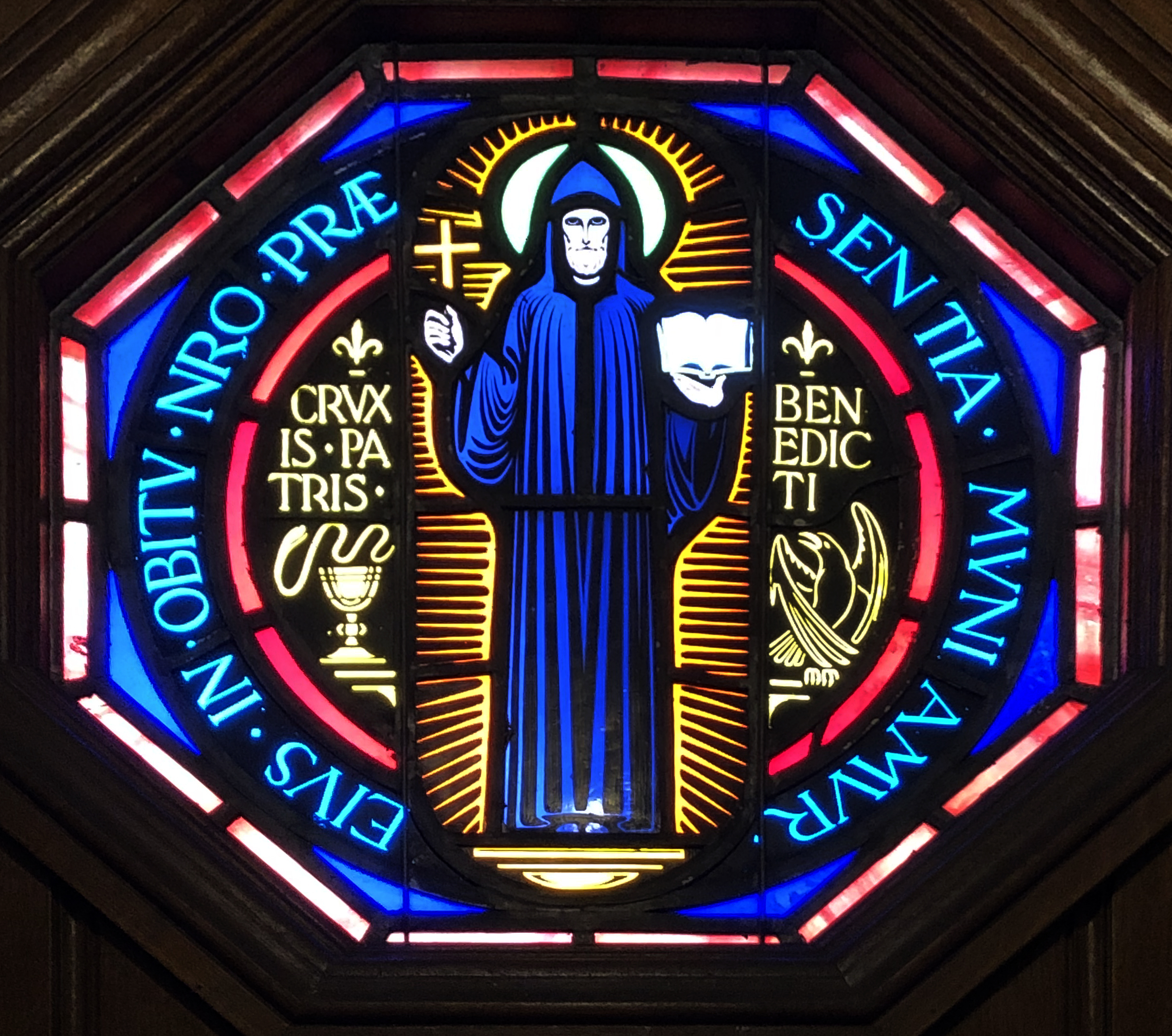
The window in the vestibule or entrance of the church is one side of the Jubilee Medal of St. Benedict. St. Benedict holds a cross and his Rule. The raven and the chalice and chalice topped by a snake are symbols that recall two unsuccessful attempts to poison him. To his sides is the Latin phrase for “The Holy Cross of St. Benedict.” Around the outside is the phrase: “May his presence strengthen us in our death.”