
What does 150 years of ministry in Oklahoma look like? The Catholic Church knows the answer
- Details
St. Gregory's Abbey and Oklahoma Baptist University Announce Land Swap
- Details
Oklahoma Baptist University announces plans for former St. Gregory's University in Shawnee
 Carla Hinton

Land that had been home to a Catholic university is being returned to the Benedictine monks that once owned it.
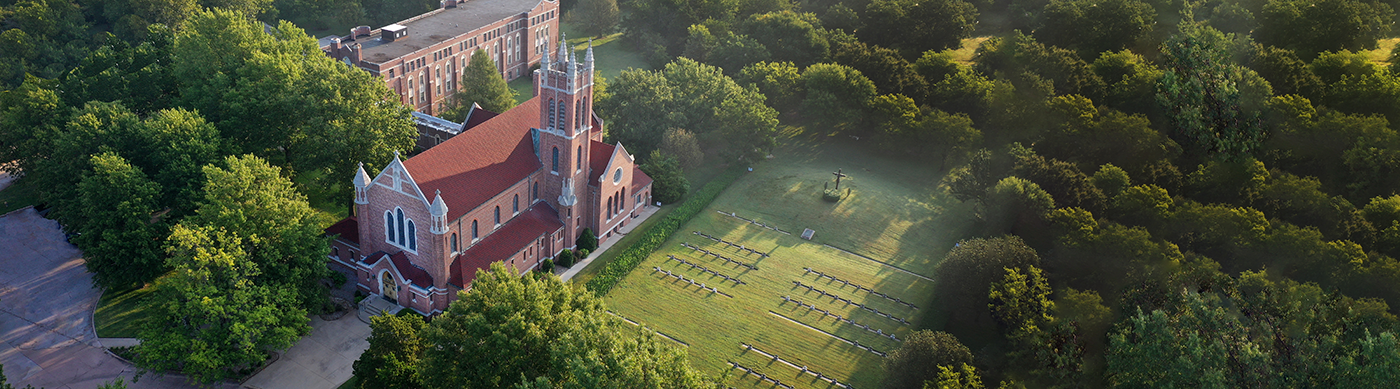
In a historic land swap on Friday, Oklahoma Baptist University returned the former 73-acre St. Gregory's University property to the St. Gregory Abbey monastic community in exchange for two parcels of land roughly totaling 134 acres in Shawnee.
Heath Thomas, OBU president, described the exchange as a "historic moment in the life of both the abbey and the life of the university."

"This exchange will benefit both entities for the good of their service and our shared mission and for the benefit of our wider Shawnee community," he said during a news conference held Friday outside the abbey church at 1500 W MacArthur in Shawnee.
"Let me say, as president of Oklahoma Baptist University, we were blessed to steward the historic St. Gregory's University for the years that we owned it, but we are delighted that this historic Catholic property will return to its true home with the abbey."
Stasyszen said the former St. Gregory's University campus property had been in the monastic community's possession since the early 1900s. He said Benedictine Hall was the first building constructed for the university in 1913. The abbot said the monks signed ownership of the St. Gregory's University land and buildings over to the university in 2012, hoping to strengthen the university, but the land ultimately became part of the university's bankruptcy proceedings several years later.
Thomas said it was important to note that OBU remained grateful to the Green family for the donation of the St. Gregory's land.

Stasyszen said St. Gregory's Abbey and the Mabee-Gerrer Museum continued to occupy their properties after the St. Gregory's University land was donated to OBU because the abbey and museum were owned by the monastic community as separate entities from the university.
Both the Abbot and Thomas talked about the positive relationship the monks and OBU have developed over the years.
For his part, Stasyszen said Thomas was one of the first people who called him after a tornado barreled through Shawnee in 2023.
The abbot said Thomas inquired "How are the monks?"
Stasyszen said OBU obtained and helped set up generators for the abbey to use when it lost power for several days after the tornado. He said the generators helped the monks keep the beef frozen that they sell through their Monks Marketplace enterprise.
Shop local, shop Catholic for Christmas
- Details
 by Sally Linhart, the Sooner Catholic.
Supporting local businesses has never been more important. The struggles that small and locally owned businesses deal with have been exacerbated this year, forcing many to shutter their brick-and-mortar locations. Catholic business owners are no exception, and support from the community is crucial for their success.
Catholic owned businesses around the archdiocese have gift ideas from soap to burp rags to tamales.
Monks’ Marketplace
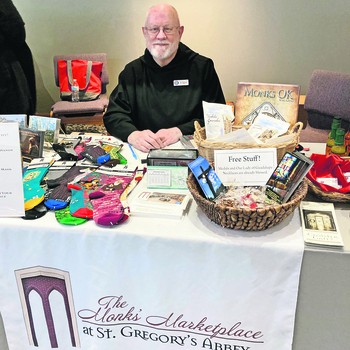
The Monks’ Marketplace at Saint Gregory’s Abbey in Shawnee is a gift shop that features handmade products made by Benedictine monks that reside at the abbey. The shop, which opened in January, sells soap, lotion, rosaries, jam and jelly. The shop also sells eggs from the abbey’s free-range hens and honey produced from the abbey’s bees as well as products from monasteries and religious communities in other states.
Anchored Okie
Saint Mark Catholic Church in Norman is home to many talented business owners as well. Anchored Okie is a custom embroidery business owned by parishioner Mekele Keilty. Keilty, a military wife, has been in business for two years and provides custom embroidery services on clothing, blankets, bags, towels, aprons and anything else that can be embroidered.
To ensure delivery in time for Christmas, orders must be placed by Dec. 10. “The typical turnaround time is 5-7 working days, depending on product availability,” Keilty said. “We have delivery and local pick-up options and currently offer free shipping on holiday orders.”
Gringo Girl Tamales and Southern Eatery
Kim Fields, owner of Gringo Girl Tamales and Southern Eatery, provides delivery of her handmade tamales. Fields’ restaurant is located at 924 E. Main Street in Norman and features a wide variety of comfort food. Menu items include chicken and dumplings, stuffed peppers, casseroles, macaroni and cheese and, of course, tamales. Weekday delivery is available in Moore and Norman, and Saturday delivery is available in surrounding areas.
Kristy’s Flowers and Gifts
In Okarche, Kristy’s Flowers and Gifts at The Center of Family Love has poinsettias and Christmas themed flower arrangements available for delivery by Christmas Eve for all orders placed by Dec. 21. The gift shop carries San Francisco Soap Company products for men and women, winter headwear, fuzzy socks, foot soaks and a line of Beer Bottle candles in scents like pilsner and ale.
Don’t leave without stopping by Holy Trinity Catholic Church gift shop in the Blessed Stanley Rother memorial building to see their unique gift offerings. Proceeds from the gift shop support youth programs and religious education classes at Holy Trinity.
Bl. Stanley Rother Store
Stumped on stocking stuffer ideas? The Blessed Stanley Rother Store at rotherstore.com has Rother coloring sheets for children that come with a set of colored pencils as well as pocket medals, pendant medals, prayer cards and rosaries featuring Blessed Stanley.
Trinity Mercantile
Edmond residents can pick up a new pair of Sock Religious socks to wear to midnight Mass from Trinity Mercantile on Broadway. For the chef, the Vatican Christmas cookbook features Swiss Guard recipes for Advent and Christmas. Other gift ideas include door hanger house blessing beads, jewelry, stickers, magnets and a large selection of books for adults and children. For a small fee, Trinity Mercantile offers custom gift-wrapping services once a week.
Game Fish Rosaries
Looking for a custom, handmade rosary with a creative twist? Check out Game Fish Rosaries on Facebook. Young entrepreneur Jaxton Finley creates custom rosaries using fishing line, weights and swivels. The seventh grader from Piedmont came up with the idea in 2019 when he was trying to think of a unique Father’s Day gift. Jaxton thinks his rosaries would make a perfect Christmas gift “because it’s Jesus’ birthday – and we need more prayers now than ever.”
Sally Linhart is a freelance writer for the Sooner Catholic.
Photo: Br. Damian Whalen, O.S.B., sells items from The Monks Marketplace. Photo Sally Linhart/Sooner Catholic.
The Monks’ Marketplace
Facebook page
(405) 878-5127
Br. John Michael invested as Novice at St. Gregory's Abbey
- Details
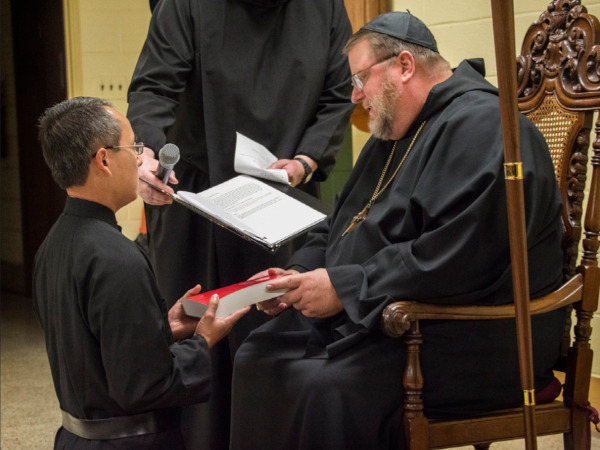 Abbot Lawrence Stasyszen, OSB and the monks of Saint Gregory’s Abbey invested Brother John Michael (Ford) Nguyen as a novice in the community on Sept. 13.
Brother Novice John Michael is from Saint Andrew Dung Lac Catholic Church in Oklahoma City. Following the ancient tradition established in Sacred Scripture, the abbot assigns the novice with a new name to signify the change in life that he is undertaking.
The names of saints are chosen to provide the novice with a role model and a spiritual companion for his life in the monastery. Br. Nov. John Michael is under the special patronage of two saints: Saint John of the Cross was a Carmelite Friar in Spain during the 16th century. He led a reform of the order, founding the Discalced Carmelite Order. He endured great suffering during his life as a result of physical illness and resistance to his reforms. He is a doctor of the Church, known for his mystical poetry and other writings that describe union with God.
Saint Michael Ho Dinh Ly lived in the 19th century, largely in Vietnam. He was a Catholic husband and father, and a successful silk merchant and high-ranking Mandarin. He used his wealth and influence to support the French Missionary Society, and to assist the poor and Vietnamese Catholics who were under persecution. He eventually was arrested during a violent persecution of the Catholic Church in Vietnam and was beheaded because of his promotion of the faith. He is known as the “Protector and Martyr of the Church” in Vietnam.
The novitiate of Saint Gregory’s Abbey is a one-year period in which novices live the monastic life intensely and are formed in monastic spirituality. It is not a period of vowed commitment, but rather a period of discernment that can lead to the profession of vows at the end of one year.
Photo: Br. John Michael (Ford) Nguyen was invested as a novice on Sept. 13. Photo Br. George Hubl, O.S.B.
https://archokc.org/news/br-nguyen-invested-as-novice-at-st-gregorys-abbey
Creating buzz: St. Gregory's Abbey finds homes for bee hives in expanded honey operation
- Details
by CARLA HINTON
Published: Tue, May 26, 2020
Article appeared in The Oklahoman
SHAWNEE —
Wanted: homes for hives.
The unusual appeal from the monks at St. Gregory's Abbey generated a surprising response.
In a move to expand their honey production operation, the Benedictines hoped to find people in the community who would be willing to house some bee hives on their properties. The Rev. Simeon Spitz, the abbey's resident beekeeper, put an ad in a local newspaper and also sent out emails in search of homes for more honey bees.
The idea of helping the monks while getting first dibs at a future honey haul proved too tempting to resist. About 15 individuals and families in Shawnee and other rural areas have agreed to house bee hives.
And who could blame them?
Sounds like a sweet deal.
"I was telling the other monks yesterday that I need a secretary to handle the calls. The phone's been blowing up," Spitz said during a recent interview.
He has spent the last week or so traveling on what he laughingly calls "reconnaissance" missions to size up the properties that will house the abbey's new sets of bee hives. The truck holding the "nucs," short for "nucleus colonies," recently arrived at the abbey and Spitz and other monks have been transferring the bees to their new homes.
Most are in Shawnee but others are in places like Macomb and Lexington.
Tony Carlile was among the first to sign up for the project.
He said one of the monks at St. Gregory's officiated at his wedding and he and his wife Debbie and their daughter Amy all graduated from St. Gregory's University.
"So we've been associated with St. Gregory's for most of our lives. It's kind of like family out there for us," he said.
"It was just one of those things when they (monks) said what they were doing, we thought we could help with that," Carlile said.
Spitz is excited to see the honey operation grow beyond what he ever imagined.
He said he was pleased when many of the monks' community friends and supporters, like the Carliles, came forward, but he's especially thrilled to get to know other individuals and families who weren't linked to the abbey in any way and now they have befriended the abbey through the expansion project.
"We just got real connected, real quick, because of the hives. We're talking like we're old friends," Spitz said.
Project part of big picture
The expanded beekeeping project always was planned as one of several revenue-generating ventures for the monastic community. Such projects arose after the closing of St. Gregory's University in 2017 as the Benedictine religious order sought new revenue streams.
For years, honey from the bee hives on the abbey property had been sold at the abbey and in the gift shop of the adjacent Mabee-Gerrer Museum of Art.
The Rev. Lawrence Stasyszen, abbot of St. Gregory's Abbey, said they are currently planning to have a total of 400 hives for the expansion project because of the community's help. He said the situation is remarkable because the original plan was to expand to 300 hives over the course of three years.
"So in our first year, we are getting to our target for Year Three. That's just a great blessing," the abbot said.
The monks had developed a strategic plan for increasing revenue that they could gain through their own resources and they identified expansion of their beekeeping and honey production as a first step "because it produces the greatest return for investment with the least amount of labor of the things that we were looking at," Stasyszen said.
Monks in the market
- Details