
Our History
Watch this video created by C-Span in February 2018
Benedictine monks first arrived in what is today the state of Oklahoma in October 1875. Fr. Isidore Robot, O.S.B., and Br. Dominic Lambert, O.S.B., monks of the French monastery of Notre Dame de la Pierre-qui-Vire, entered the Indian Territory at the suggestion of the Bishop of Little Rock, Arkansas. Spending their first few months in Atoka, the pioneer monks eventually settled with the Citizen Band Potawatomi Indians. In 1876, they established Sacred Heart Abbey, near what is present-day Konawa, Oklahoma. Along with communal monastic observance, the pioneer monks also established a school for the children of Native Americans and white settlers of the region. The monastery at Sacred Heart was known for its strict observance, its generous hospitality, its model farm, and its beautiful formal gardens.
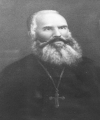 Our founder, Rev. Isidore Robot, O.S.B. was named Abbot honoris causa and the first Prefect Apostolic of the Indian Territory. In many ways, he can be considered the founder of the Catholic Church in what is today Oklahoma. He is buried in the cemetery at Sacred Heart Mission near Konawa.
In addition to their monastery and schools, the Benedictines of Sacred Heart Abbey established over 40 parishes and missions throughout the Oklahoma and Indian Territories, including several present-day parishes in the Archdiocese of Oklahoma City and the Diocese of Tulsa. In fact, Rome chose the first two Prefects Apostolic for Oklahoma from among this group of missionary Benedictines. In this way, one can say that the Church in Oklahoma is built upon the foundation laid by Benedictine monks.
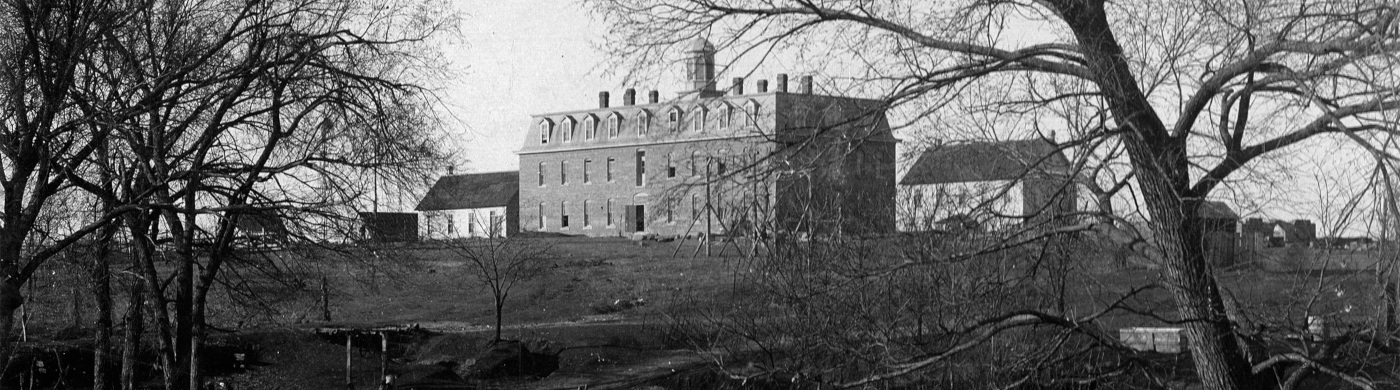
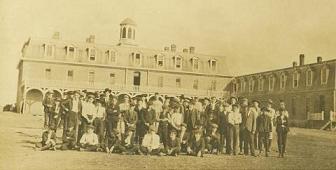
In 1901, disaster struck when a devastating fire destroyed practically all of Sacred Heart Mission on a cold January night. The monks were dispersed until a new monastery and school could be constructed. Determined to succeed, the monks built a second monastery and school complex at Sacred Heart. Its foundations are still visible at the mission site to this day.
These historic photographs record the appearance of the second monastery and school at Sacred Heart.
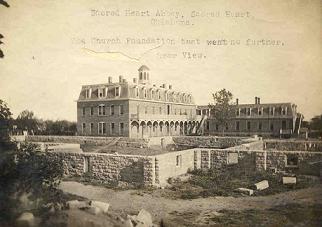
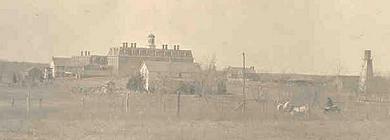
Although they were determined to rebuild at Sacred Heart, the monks decided to accept an invitation to establish a school in the territorial city of Shawnee, some 30 miles north of the original mission. The new school was incorporated as the Catholic University of Oklahoma, but was known as "St. Gregory's High School and College" from its earliest years. In fact, the cornerstone bears the name of St. Gregory the Great.
Pictured below is a rare photo of the monumental administration building under construction at Shawnee and an aerial photo of the campus of St. Gregory's dating from around 1927.
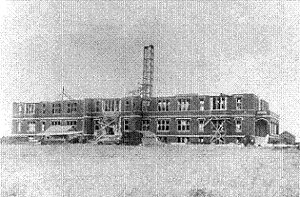
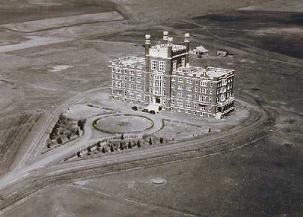
The foundation at Shawnee began to thrive, while the newly reconstructed monastery and school at Sacred Heart began to decline as the railroad and the economy shifted toward the northern end of Pottawatomie County. And so, although a new monastery complex was constructed at Sacred Heart, the activity of the community became increasingly centered at Shawnee. For this reason, the monastic community was transferred to Shawnee in 1929 and the name changed to St. Gregory's Abbey. Along with the change in name, the monastic community broke its ties with its French roots, and joined the American Cassinese Congregation of monasteries. The monastery buildings at Sacred Heart were abandoned in the late 1940's and were razed in the mid 1950's. The original mission site, however, has been listed on the National Register of Historic Places, and hundreds of visitors come to the site each year to view the structures and foundations that remain, to visit the cemeteries of the Benedictine monks and the Mercy sisters, who operated a school for girls at the mission, and to enjoy the beautiful scenery.
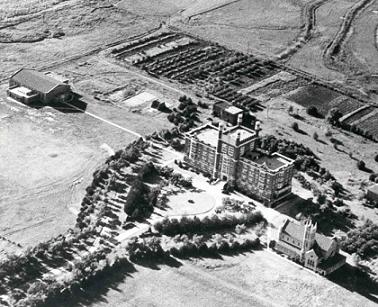
The picture at the right shows the appearance of the grounds of St. Gregory's around the year 1950.
Since their move to Shawnee, the Benedictines of St. Gregory's Abbey have continued to serve the Church in Oklahoma and beyond through their witness to contemplative life and daily prayer, their mission of Catholic education at St. Gregory's University until its closure in 2017, and pastoral duties at parishes near the monastery. There are currently 16 members of St. Gregory's Abbey, most of whom reside at the monastery. In addition to their duties at the Abbey, several of the monks assist with weekend masses at parishes around Oklahoma.
Sacred Heart Abbey & School
After the pioneer monks arrived in Indian Territory on October 12, 1875, they began to search for a suitable location for a permanent monastery and school. In spring of 1876, the monks accepted an offer of land and hospitality offered by the Citizen Band Potawatomi. This site, located about 30 miles south of the community's current location at St. Gregory's, eventually became Sacred Heart Abbey and school. It was a center of spiritual life, education and culture until 1929, when the monks transferred all activities to the new monastery and school in Shawnee. Most of the surviving structures were dismantled in the 1950s.
Today, the peaceful grounds are maintained by members of the neighboring rural parish of Sacred Heart. Two cemeteries provide the resting place of the founding monks as well as the Sisters of Mercy who operated St. Mary's Academy, a school for girls on the mission property. Buildings from the 1880's still grace the property, as well as the foundations of the monastery and school complex. The site is listed on the National Register of Historic Places, and is open to visitors during daylight hours. For directions to Sacred Heart, please contact St. Gregory's Abbey at 405-878-5491.
We hope that you will enjoy these images of the spring at the site of Sacred Heart Abbey and School. They were taken on Easter Monday, 2004.
The entrance lane to the historic site rises up a hill through through Catalpa trees. In the background one can see the impenetrable hedge of "Mock Orange" bushes that lines the eastern side of the monastery site. This delicate white flower blooms in the midst of the fierce thorns of the Mock Orange hedge that was planted by the monks at Sacred Heart Monastery. The plant is not native to Oklahoma. Legend states that the plant that was used for the Crown of Thorns placed on the head of Jesus. In light of that legend, the pure white flower provides a nice meditation for Easter Monday, when the photograph was taken.
-
The Bakery
Perhaps the most picturesque surviving structure at Sacred Heart is the Bakery. Constructed of native sandstone, its cornerstone is dated 1881 and - perhaps ironically - it was one of the only buildings to survive the great fire of 1901, which destroyed the monastery complex.
-
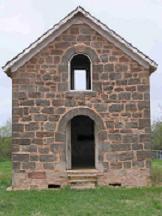
The front entrance of the bakery faces the south.
-
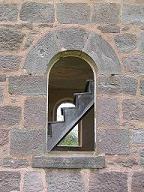
This detailed image shows the east window to the ground floor of the bakery, and the interior stairway.
-
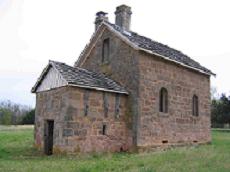
This view takes in the northwest corner of the bakery. The door leads to a basement level of this three-level structure.
- 1
- 2
- 3
- 4
- 5
- 6
- 7